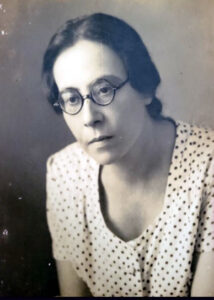
 Ellen Gottschalk Roy
(15 August 1904 – 13 December 1960)
“Freedom is the progressive disappearance of all restrictions on the unfolding of the potentialities of individuals” (In Man’s Own Image)
Who was Ellen Gottschalk Roy?
Ellen Gottschalk Roy was one of the founders, co-creator, and co-architect of Radical Humanism. Born in Paris, she was a radical writer, philosopher, thinker, editor, organizer, internationalist, and theorist who wrote extensively on radical democracy, freedom, and fascism. She played a crucial role in institutionalizing the Radical Humanist Movement through her organizational work, publishing, and advocacy.
As a committed cosmopolitan humanist and transnational feminist, she was committed to justice, dignity, and equality. Living through the horrors of Fascism, Nazism, and Stalinism, while witnessing the devastation caused by the wars, she devoted her life to the quest for truth, developing a free and just world.
“When you are born in one country, and your mother belongs to another, and your father to a third, and, endowed with his citizenship, you are a foreigner in every country where you have grown up and studied and subsequently lived and worked, and yet feel at home in all of them; if then you marry an alien from a different continent altogether and become at home there too, it must teach you something. You see the good and the bad in all countries and peoples and you cannot bear the thought that the differences are worth being ironed out by war.”
(Ellen Roy 1955 during her visit to the USA)
Ellen’s Birth and Early Life
Ellen Gottschalk Roy was born on 15 August, 1904 in Paris. Her father, Oscar Gottschalk, was German by birth, migrated to the USA in 1881, and became an American citizen in 1886. He joined the American Consular Services and was stationed in Paris from 1890 to 1906. He married Ellen’s mother, Adele Fritzler, in 1903. Ellen was their first child. She had a younger brother, Robert, and a sister, Louise.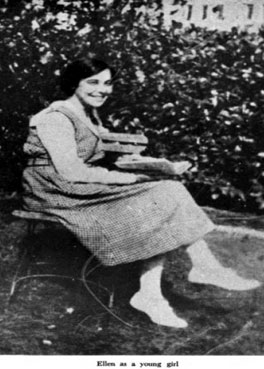 The Gottschalk family lived in Paris until 1906, when Oscar was transferred to Cologne as a Special Commissioner of the US Treasury Department. Ellen was ten years old when the First World War broke out in 1914. In 1917, the United States joined the war on the side of the Anglo-French Allies. Together with his consular colleagues, Oscar was interned and sent to Switzerland.
Ellen was then thirteen, and the sight of her father and his friends being put away in a sealed van and taken away “like wild animals” left a deep impression on her young mind. Her mother was permitted to stay in Cologne with her three children. But her mother was compelled to report daily to the local police station. For Ellen, this was a more distressing experience of how her poor and sick mother was treated.
Ellen was further distressed when she saw how women who worked in the munitions factory, handling and packing shells, suffered due to the effects of handling toxic chemicals, which turned their skin green in colour. Then, one day, the factory blew up, causing their death. Ellen recollected later that this experience made her feel like `an underdog.’ She opposed war since then and began her lifelong search for peace based on freedom and social justice.
However, Ellen excelled in school and “graduated at the top of the class” while also learning to play piano. She was accepted as a soprano by the Gurzenich Hall, Choral Division of the Cologne Symphony Orchestra.
At the end of the war, Oscar returned to Cologne. Adele died in 1920, and Oscar remarried in December 1921. However, Ellen rebelled against the peevish paternalism, and because of her circumstances, she left home in 1923 and moved to Frankfurt. She was nineteen then. And from this time onwards, she managed her own life. 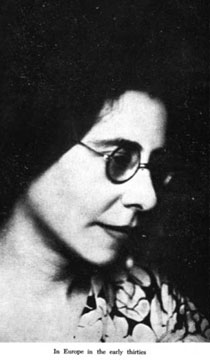 To earn a living, Ellen has to abandon her musical career and formal academic study. She took secretarial lessons and learned shorthand to become financially independent. She also became fluent in German, Russian, French, and English. Ellen began earning her living while working as a stenographer, translator, interpreter, and freelance journalist. Ellen soon moved to Berlin, where she was drawn to various radical movements.
Ellen’s Life and Career
Ellen joined the German Communist Party in 1927, but did not renew her membership after the Comintern took an extreme left position at its Sixth Congress in 1928. However, she remained active and cultivated friendly relations with many radical-minded artists, writers, and activists. Some of these figures include Ernst Toller, Emil Ludwig, Heinrich Mann, and Max Barthel.
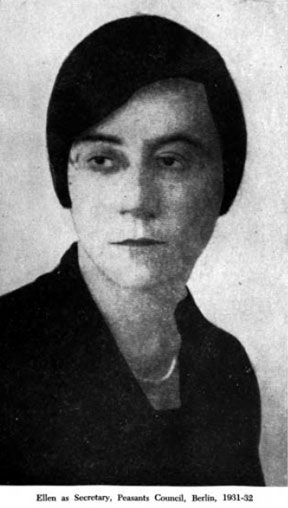
She also joined several organizations, such as the International League Against Compulsory Motherhood, the Theatre of the Masses, and the International Workers’ Aid. She also served as a Secretary of the European section of the Peasant’s International (Krestintern).
Ellen also edited the Berlin Journal and was engaged as a research assistant by Professor Rudolf Olden. She collaborated in editing the Brown Book of Nazi terror and White Book on the pogroms in Germany.
“If the fight against Fascism is one for freedom and progress, the latter must be given a concrete content. The peasant and Indian workers cannot think in abstractions. It has become an axiom that freedom means freedom from want, and progress stands for the elevation of human beings out of the animal state, where all activity serves only sheer physical maintenance, to a state of dignity where every human being can think higher ideas and pursue nobler ideals. And that the pursuit of freedom and progress in this sense must be declared a policy, and elaborated in terms of politics and economics, which the people will understand and appreciate, and for the realization of which they will fight any obstacle on the way, but only as an obstacle on the way to something to be achieved.”
(in an Essay on Win the People to Win the War, May 20, 1942)
How and When Did Ellen meet MN Roy?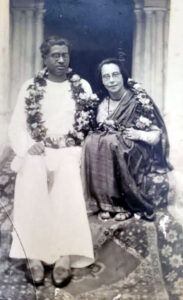 Ellen met M.N. Roy in 1928 in Berlin. They met at various cafes like Romanische Café, Gerold am Knie, Café am Zoo, and Jester. They collaborated to translate important works. During 1929 and 30, Roy introduced Ellen to some of his friends and associates in Germany. Towards the end of 1930, Roy bade farewell to his colleagues in Germany, spent several days with Ellen in the Tyrolean Alps, and then moved to India. Ellen went back to Berlin.
In India, M.N. Roy was arrested on 21 July 1931. He was jailed from 1931-1936. During this time, Roy regularly wrote letters to Ellen from different jails he was imprisoned in, such as Cawnpore, Bareilly, Allahabad, Almorah, and Dehradun. She supplied books, literature, and other material. These letters were published later as Letters from Jail in 1943. But Ellen’s letters to Roy were not preserved. Yet, these letters revealed the intimacy of their relationship and the projects they planned to pursue together after the release of MN Roy.
She also initiated a campaign for his retrial and early release. Ellen combatted the calumnies spread by Roy’s enemies and kept Roy informed of the developments in Europe and the Communist movement. She wrote to several leaders, including Jawaharlal Nehru, Stafford Cripps, Fenner Brockway, Einstein, Rolland, Longevin, among others. She organised public opinion in Europe and America in support of Roy’s early release from prison. Because of these efforts, Roy’s imprisonment was reduced from twelve to six years.
During this time, Ellen survived by taking up secretarial work. In 1934, she translated Frazer’s The Golden Bough and kept in close touch with the Brandler-Thalheimer. She also studied Freud, Jung, and Adler and prepared summaries and translations of papers on psychoanalysis. In 1935, Ellen worked as one of the main organizers-interpreters at the International Congress in Defence of Culture, held in Paris.
Meanwhile, in April 1934, Ellen visited England and also contacted the Royist group in Bombay. She also worked with Willi Munzenberg and met Pandit Jawaharlal Nehru in the winter of 1935-36. Roy was released from jail on 20 November 1936. However, Ellen faced difficulties in getting a visa.
 Ellen Came to India in 1937
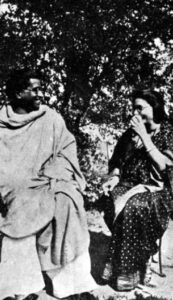
Despite being pressurised by the US government to go `home’ Ellen managed to obtain a visa from the British Consulate and arrived in Bombay on 4 March 1937. She married M.N. Roy on 10 March 1937 under the Special Marriage Act. This was solemnized in the Office of the Registrar of Marriages, Bombay.
She co-created the Radical Democratic Party in 1940 and the Indian Renaissance Institute (IRI) in August 1946. Ellen worked in the capacity of the Secretary of the IRI. She was one of the co-creators of the IRI and dedicated her life to institutionalizing and expanding the Radical Humanist Movement.
The first issue of the Independent India was published on 4 April 1937 with the little savings Ellen had brought with her from Europe.
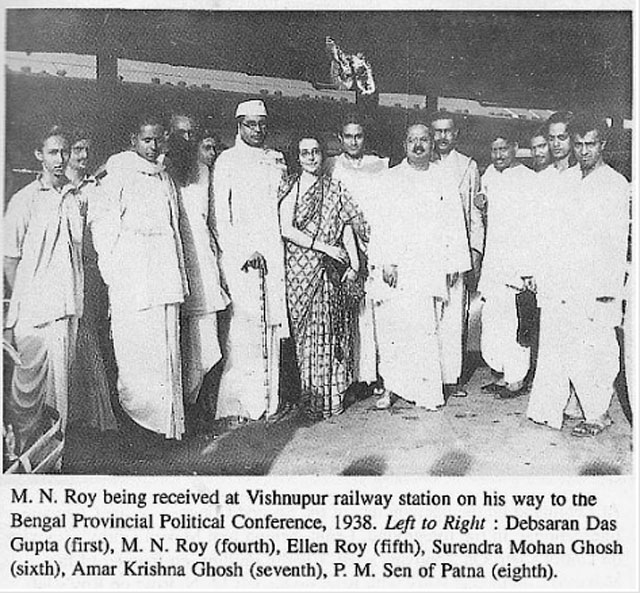
In 1938, the Roys rented a cottage at 13 Mohini Road, Dehradun, which became their home.
Ellen travelled extensively across India with Roy and took shorthand of all his public lectures, which later appeared in Independent India or in the form of books. For its international section, Ellen also translated material from French and German to publish in the Independent India.
Ellen shaped publications associated with the movement, including Independent India, The Radical Humanist, The Marxian Way, The Humanist Way, and Renaissance Publishers at Calcutta, as the movement’s main publishing institute.
 Ellen Gottschalk Roy’s Writings
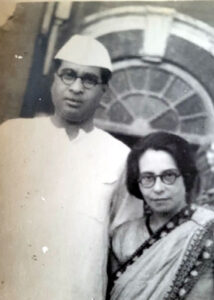
Her key works include Radical Democracy. This was published in 1944. The World Her Village: Selected Writings and Letters of Ellen Roy (Edited by Sibnarayan Ray), From the Absurdity to Creative Rationalism (Edited by Sibnarayan Ray) and In Man’s Own Image (1948, co-authored with Sibnarayan Ray).
She has also contributed articles and essays to Independent India, Radical Humanist, and other publications. Moreover, Ellen also wrote about literary and non-political subjects, some of which were published in the Radical Humanist, such as the reviews of several books, including The Thaw by Ilya Ehrenburg.
Ellen dedicated her life to the Radical Humanist Movement. She toured different parts of the country, organized intellectual gatherings and seminars to expound the basic theories and fundamental principles of the Indian Renaissance. Ellen motivated young minds to proactively take up the cause of secular humanism.
 After Roy’s Death, Ellen Stayed in India
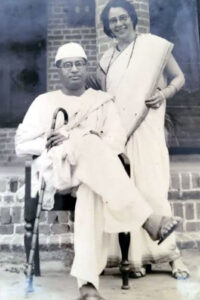
When M.N. Roy died in 1954, Ellen remained in India and played a key role in sustaining and institutionalising the Radical Humanist movement. She considered India her home.
She jointly edited the Radical Humanist weekly with Professor Sibnarayan Ray. Regularly, she sent transcripts of Roy’s unpublished speeches preserved in her notebooks. She classified, preserved, and collated materials that were brought out as books by the Renaissance Publishers.
Ellen represented the Indian Radical Humanist movement on the Executive Board of the International Humanist and Ethical Union, founded in Amsterdam in 1952. In 1955, Ellen travelled to the UK, Europe, and the United States. In her Travel Diary, she wrote about the nature and her experiences of meeting different people.  As a Secretary of the Indian Renaissance Institute, Ellen built up the M N Roy Archives, revived the annual study camps and reunions, resumed winter tours, activated the rationalist groups, and organized conferences. She played a key role in compiling the text of Reason, Romanticism, and Revolution, written by M.N. Roy, and edited his other writings.
She also looked after Renaissance Publishers as a Co-director with Professor Sibnarayan Ray and planned its publications. Her remarkable dedication to the cause continued until her tragic, brutal murder in December 1960. Ellen’s untimely death was an irreparable loss to the Radical Humanist Movement.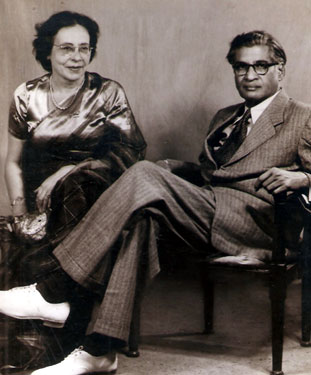
“It (Radical Democracy) means that the interest of the majority of the people…. demands that democracy be extended from formal political to essential economic democracy, the privileges and material gains of power will be shared by all the constituents of the ruling power, which is, the people. They will no longer be the prerogatives of individual rulers, or ruling classes.”
(Ellen Roy, 1945, Radical Democracy)